
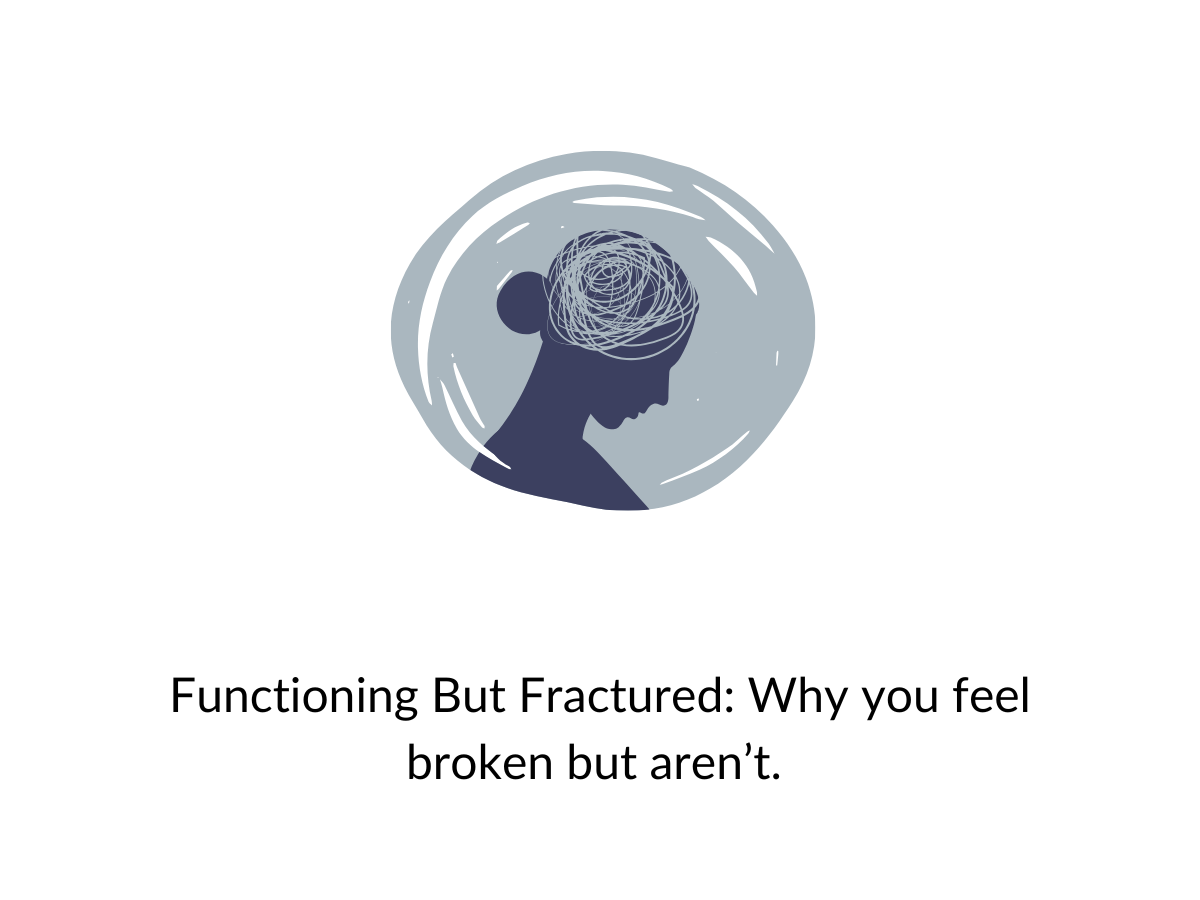

You look fine. But inside? It’s a different story.
You show up, smile, tick the boxes. Maybe you hold a job, raise kids, keep the house going, support everyone else — and people say, “You’re so strong.” But inside, there’s a quiet dread. You’re exhausted. On edge. Lonely, even when you’re surrounded.
You might wonder: What’s wrong with me? Why can’t I enjoy any of this? Why do I feel broken, even when life looks okay on the outside?
This is what I think of as functioning but fractured.
And if you recognise yourself here — it’s not because you’re weak or failing. It’s because you’ve been carrying too much, for too long, with too little support.
What Functioning but Fractured Really Means
Functioning but fractured describes a state many women live in without realising it. It’s the experience of keeping everything going on the surface — work, family, responsibilities — while feeling emotionally splintered underneath.
You might:
- Struggle to relax, even when nothing is “wrong”
- Feel numb, disconnected, or emotionally flat
- Have an inner critic that never lets up
- Cry in secret, then wipe your face and carry on
- Apologise for having needs or feelings
- Go quiet instead of asking for support
These aren’t signs of failure. They’re symptoms of relational trauma — the kind that doesn’t always come from one big, obvious event, but from years of walking on eggshells, minimising your needs, or trying to earn love through being useful or good.
The Hidden Cost of Survival Mode
If you grew up in a household where emotions were unsafe, ignored, or punished — or if you’ve spent time in adult relationships where you had to shrink yourself to keep the peace — your nervous system adapted to keep you safe.
That might look like:
- Staying busy all the time
- Overthinking every conversation
- Feeling panicked when you’re criticised
- Struggling to know what you feel, let alone express it
- Saying “I’m fine” when you’re absolutely not
This is survival mode — and it works, which is why so many people never realise they’re still in it. But it comes at a cost. The cost is emotional depletion, disconnection, and a lingering sense that something is wrong with you — when in fact, something happened to you.
You’re Not Broken — You’re Over-Adapting
Therapy clients often say things like, “I should be able to cope,” or “Other people have it worse.” But trauma isn’t about comparison. It’s about what happened inside you when you weren’t seen, soothed, or safe.
“Functioning but fractured” isn’t a diagnosis — it’s a survival story. And if you’re here, it means your body and brain did exactly what they needed to do to get you through.
But now? You deserve more than just coping. You deserve to heal.
How Therapy Can Help
Therapy gives you space to:
- Understand your patterns through the lens of attachment and relational trauma
- Learn to name and regulate your emotions, without shame
- Challenge the inner critic that’s been driving you
- Build safer relationships — with others and yourself
You don’t have to stay stuck in survival mode. Healing doesn’t mean becoming someone else — it means becoming more fully yourself, without the constant background noise of fear, guilt, or shame.
Ready to stop just surviving?
If this speaks to you, therapy could be the next step. You’re not too much. You’re not too broken. You’re functioning — but you don’t have to stay fractured.
Contact me here to explore how we can work together.
Further Reading:
External Resource:
© Maggie Maher Therapy. All content for informational purposes only and not a substitute for professional mental health care.


0 Comments