
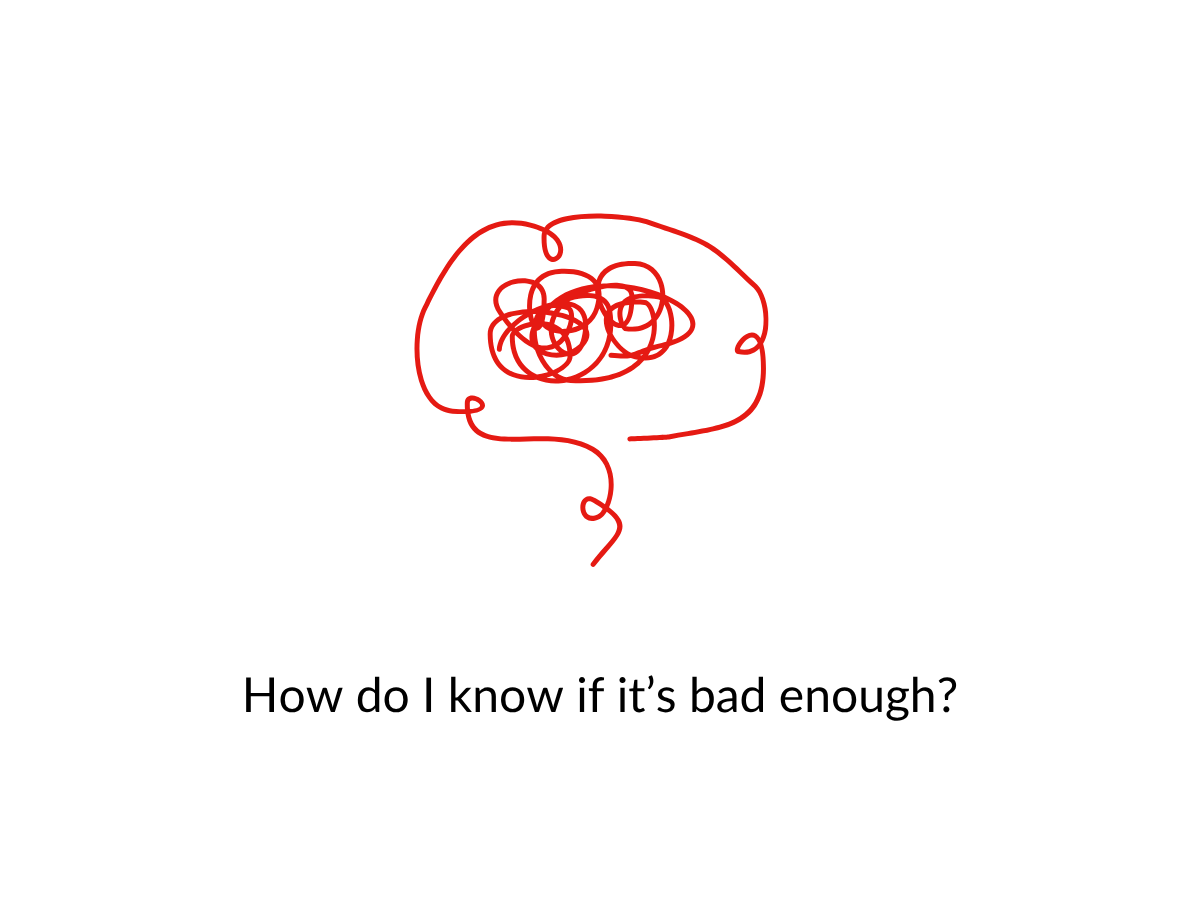

“I don’t know if it’s bad enough.”
It’s something I hear surprisingly often in therapy. Sometimes someone is talking about a relationship in which they feel criticised, controlled or constantly on edge. Sometimes there have been repeated arguments, broken promises or behaviour they know they aren’t comfortable with. And sometimes there is nothing they can easily point to at all. They simply know that they are unhappy, exhausted, increasingly unlike themselves or relieved when their partner isn’t around.
But almost immediately, another part of the conversation begins.
Maybe they’re overreacting. Maybe all relationships are difficult. Their partner can be lovely too. Other people have it much worse. Perhaps they haven’t communicated clearly enough. Maybe they need to be more understanding. And surely you shouldn’t consider ending a relationship unless something is really wrong?
So instead of asking what the relationship is actually like for them, they begin trying to establish whether it meets some imaginary threshold for being bad enough.
How do I know if my relationship is bad enough?
When people ask whether a relationship is bad enough, they are often looking for something objective. A line that separates ordinary relationship difficulties from the kind of problems they are officially allowed to take seriously.
This can lead to an enormous amount of evidence gathering. You might replay arguments and try to remember exactly what was said. You may search online for descriptions of unhealthy relationships and compare them with your own. You might tell a friend what happened and watch their reaction carefully. Perhaps you keep screenshots or messages because part of you worries that later you will convince yourself it wasn’t really that bad.
Then comes the comparison. Yes, they said that, but they’ve never hit me. Yes, I feel anxious around them, but they had a difficult childhood. Yes, they can be controlling, but they’re also a brilliant parent. Yes, I’m unhappy, but other people have much worse relationships.
The problem is that there is almost always something worse to compare your experience with. If “bad enough” is measured against the worst relationship you can imagine, the threshold can keep moving indefinitely.
Why certainty can feel so important
It would be easy to say that the answer is simply to trust yourself more. But if you’ve spent months or years questioning whether your experience is legitimate, being told to “trust your gut” may not be particularly helpful.
I’m often more interested in why certainty feels so necessary.
What would it mean if you decided something was wrong and later discovered you had been unfair? What if you left and regretted it? What if your partner told everyone you had destroyed the relationship? What if your children were upset? What if your family thought you should have tried harder? What if you were the problem after all?
Suddenly, establishing whether the relationship is objectively bad enough has a very important job.
If you can become completely certain, perhaps you can make a decision without guilt. Perhaps nobody can accuse you of overreacting. Perhaps you won’t have to wonder afterwards whether you should have stayed. Perhaps you can protect yourself from making a terrible mistake.
From that perspective, the endless analysis isn’t irrational. It makes emotional sense.
Sometimes not knowing protects us too
There can also be another uncomfortable layer to uncertainty.
If you are still trying to decide whether something is bad enough, you don’t yet have to decide what you are going to do about it.
That may matter enormously.
Because acknowledging that a relationship is having a significant impact on you can bring you face to face with much bigger questions. Do I need to say something? What happens if nothing changes? Would I ever leave? What would happen financially? Where would I live? What about the children? What would other people think? What if my partner became angry? What if I ended up alone?
Even recognising that you are deeply unhappy can feel threatening if you believe that recognising the problem means you must immediately solve it.
So uncertainty can create a kind of temporary middle ground. As long as you are still investigating whether your experience qualifies as “bad enough”, you can postpone all the frightening questions about what might happen next.
That doesn’t mean you are deliberately avoiding reality. It means part of you may have very understandable reasons for not wanting to know yet.
“But they’re lovely sometimes”
One of the things that makes difficult relationships particularly confusing is that they usually aren’t difficult every minute of every day.
There may be holidays you genuinely enjoyed, evenings when you laughed together, thoughtful gestures, periods when things felt much better and parts of your partner that you still love. After a terrible argument, you might have a lovely weekend. Someone who can be critical may also be supportive when you are struggling. A partner who behaves badly during conflict may be warm and affectionate at other times.
People sometimes believe that these positive experiences cancel out the difficult ones. If they were really that bad, surely they wouldn’t also be capable of being so lovely.
But relationships are rarely that simple.
You don’t have to decide that somebody is entirely bad in order to acknowledge that aspects of your relationship are hurting you. Nor do the good experiences become fake simply because there are serious problems.
Both can be true.
In fact, the existence of genuinely good parts of a relationship can be one of the reasons it is so difficult to understand what you are experiencing. You aren’t choosing between a completely terrible person and a completely wonderful one. You are trying to make sense of a complicated relationship with someone you may still care about very much.
When you keep putting yourself on trial
If you have become used to having your perspective challenged, you may find yourself approaching your own experience almost like a court case.
You need examples. Dates. Context. Witnesses. Evidence that another reasonable person would reach the same conclusion.
And the prosecution and defence are both apparently being run by you.
You remember something hurtful, then immediately provide the mitigating circumstances. They were stressed. They didn’t mean it like that. I probably didn’t explain myself very well. I was angry too. They apologised afterwards.
Context matters, of course. We all behave badly sometimes. Understanding another person’s behaviour can be useful.
But understanding why someone behaved a certain way and recognising the effect their behaviour has on you are two different things.
You can understand why somebody struggles with anger and still be affected by being shouted at. You can have compassion for someone’s childhood and still dislike how they treat you. You can recognise your own contribution to relationship difficulties without accepting responsibility for everything that happens between you.
You don’t need to win the case against your partner before you are allowed to notice what the relationship is like for you.
What if I really am overreacting?
For some people, this is the question underneath everything.
Perhaps you grew up learning that your feelings were excessive. You were too sensitive, too dramatic, difficult or selfish. Perhaps maintaining relationships meant learning to understand everyone else’s perspective before trusting your own.
Or perhaps a current relationship has gradually left you less certain of yourself. You now run your reactions through an internal checking process before allowing yourself to believe them. Would someone else be upset by this? Am I being reasonable? Can I prove what happened?
In that context, doubting yourself may not simply be low confidence. It can be a way of protecting relationships.
If you assume that you might be wrong, you keep looking for another explanation. You give another chance. You try a different approach. You take responsibility for repairing things.
That strategy may have helped you maintain important relationships for a very long time.
The question isn’t whether you should suddenly stop considering other people’s perspectives. It is whether your own perspective gets a place in the room too.
Bad enough for what?
Sometimes I think this is a more useful question.
When you say “I don’t know if it’s bad enough,” finish the sentence.
Bad enough to be upset?
Bad enough to talk to somebody about it?
Bad enough to ask for change?
Bad enough to say no?
Bad enough to set a limit?
Bad enough to get support?
Bad enough to leave?
Those are very different questions.
You do not need to know whether you will eventually leave a relationship in order to acknowledge that something happening within it is hurting you now.
You also don’t need to make a permanent decision simply because you have started taking your experience seriously.
Sometimes people avoid looking closely at their relationship because they fear that once they admit something is wrong, there will be only one acceptable conclusion. But therapy doesn’t have to begin with deciding whether you should stay or leave.
It can begin with understanding.
A different question to ask about your relationship
Instead of asking whether your relationship is objectively bad enough, try becoming curious about what it is actually like to be you within it.
Are you able to disagree without spending hours worrying about the consequences? Can you say what you need? Do you find yourself carefully choosing when to raise things because you are anticipating a reaction? Are you frequently explaining or defending perfectly ordinary choices? Do you feel responsible for managing your partner’s mood? Are you becoming quieter, more anxious or less certain of yourself? Do you feel noticeably relieved when they aren’t there?
None of these questions provides a mathematical answer about whether you should end a relationship. That isn’t the point.
They bring your attention back to your lived experience rather than asking you to build a case.
You might also notice what happens internally when you imagine no longer asking whether it is bad enough.
Perhaps a thought appears immediately: Then I might have to do something.
Or: Then I’d be blaming them.
Then I’d have to admit how unhappy I am.
Then I couldn’t keep hoping it will sort itself out.
Then what if I’m wrong?
Those responses are important. They begin to tell us why uncertainty has been necessary.
You don’t have to decide today
Taking your own experience seriously is not the same as making an immediate decision about your relationship.
You are allowed to notice that something hurts before knowing what you want to do about it. You are allowed to acknowledge that a relationship is affecting you even if there are also good parts. You can become clearer about what you need without already knowing whether the relationship can provide it.
And if part of you keeps returning to “But is it really bad enough?”, that part may not need to be argued with.
It may need to be understood.
Perhaps it is trying to protect you from guilt, regret, conflict, judgement or the enormity of what might come next. Perhaps it believes you need an unarguable case before you are allowed to trust yourself.
Therapy can help us understand those fears rather than simply replacing them with another instruction to “trust your instincts”.
Because eventually the question may become less about proving how bad somebody else is and more about becoming able to recognise what your own experience is telling you.
You don’t need to prove that somebody is a terrible person before you are allowed to take seriously the effect a relationship is having on you.


0 Comments